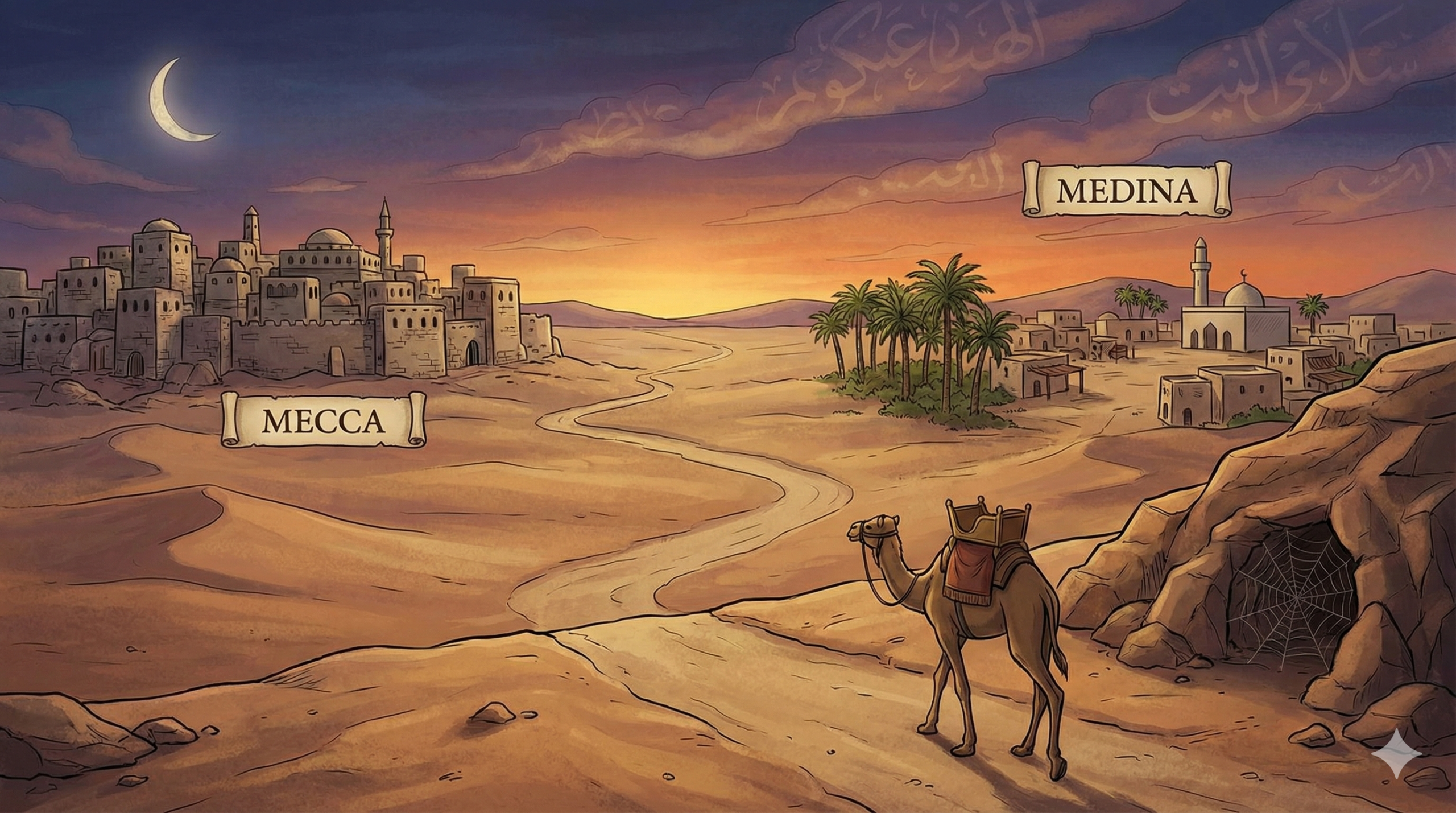
As an amateur historian of the Middle East and a student of Islamic studies, I find that the journey of Muhammad (PBUH) from a merchant in Mecca to the leader of a burgeoning community in Medina is one of the most compelling narratives in human history. To understand the foundations of Islamic civilization, we must examine the pivotal years that defined the Prophet’s mission.
The following article, adapted from historical records and oral traditions, explores the early challenges and the eventual migration that changed the course of the world.
The Rise of a New Faith: From the Mountains of Mecca to the Oasis of Medina
The story of Islam begins in the rugged terrain of the Hijaz (the western region of the Arabian Peninsula), specifically within the city of Mecca. For the first thirteen years of his mission, Prophet Muhammad (PBUH) preached a message of strict monotheism and social justice to a society deeply rooted in tribal polytheism and economic inequality.
The Meccan Struggle and the Search for Refuge
In Mecca, the early Muslim community faced severe persecution. The Quraysh, the dominant tribe and custodians of the Ka’bah (the sacred cuboid building in Mecca), viewed the new faith as a threat to their social order and economic interests.
- Social Ostracization: Early converts, particularly those from lower social strata or without tribal protection, were subjected to torture and boycotts.
- The Year of Sorrow: The Prophet suffered deeply personal losses with the deaths of his wife, Khadijah, and his protective uncle, Abu Talib. This left him more vulnerable to the hostility of the Meccan leadership.
- The Visit to Ta’if: Seeking a new base for his message, the Prophet traveled to the city of Ta’if. However, he was met with rejection and violence, marking one of the most difficult moments of his life.
The Pledges of Aqaba: A Turning Point
Despite the hardships in Mecca, the message of Islam began to reach pilgrims visiting the city. Significant breakthroughs occurred at a location called Aqaba, where delegations from the northern city of Yathrib (later renamed Medina) met with the Prophet.
- The First Pledge of Aqaba: A group of twelve men from Yathrib accepted Islam and pledged to follow moral and ethical principles, such as avoiding theft, adultery, and the killing of children.
- The Second Pledge of Aqaba: A larger group of seventy-three men and two women pledged not only their faith but also their physical protection to the Prophet and his followers.
This second pledge was the catalyst for the Hijra (the migration), a move that would transform the Muslims from a persecuted minority into a political and social entity.
The Hijra: The Great Migration (622 CE)
The migration to Medina was not a simple journey; it was a high-stakes escape. The Meccan leaders, fearing the Prophet would establish a base of power to the north, plotted to assassinate him.
- The Escape: While his companions emigrated in small groups, the Prophet remained until the final moment. He escaped his home while it was surrounded by assassins, leaving his cousin Ali ibn Abi Talib in his bed as a decoy.
- The Cave of Thawr: Accompanied by his close friend Abu Bakr, the Prophet hid in a cave on Mount Thawr for three days to evade Meccan search parties.
- The Arrival in Quba: Before entering the heart of Medina, the Prophet stopped in the suburb of Quba, where he established the first mosque in Islamic history.
Life in Medina: Building a New Society
Upon arriving in Medina, the Prophet faced the monumental task of uniting a diverse population. The city was home to various Arab tribes—notably the Aws and Khazraj—as well as several Jewish communities.
To create stability, the Prophet implemented several social and political reforms:
- The Brotherhood (Mu’akhah): To integrate the Meccan refugees (Muhajirun) into Medinan society, the Prophet paired each refugee with a local supporter (Ansar). This created a bond of brotherhood that transcended tribal lineage.
- The Constitution of Medina: This historical document established a confederation between the Muslims, the Jews, and other groups. It granted religious freedom and required all parties to defend the city against external threats.
- The Construction of the Prophet’s Mosque: The Masjid al-Nabawi became the spiritual, social, and political heart of the community.
Conclusion: A Legacy of Resilience
The transition from Mecca to Medina was more than a change of geography; it was a transition from survival to statecraft. For students of history, this period illustrates how a marginalized movement can reshape its destiny through strategic alliances and a steadfast commitment to its core values.
Join the Conversation We hope this overview provides a clear historical perspective on these foundational events. History is best understood through dialogue and inquiry.
- What aspects of the Hijra do you find most significant from a political or social standpoint?
- How do you think the “Brotherhood” system influenced the social fabric of early Medina?
Please leave your questions or comments below. Whether you are a student of history or a curious reader, we look forward to hearing your thoughts!
Leave a Reply