Category: Arabia

  • 1 – Arabia Before Islam

    1 – Arabia Before Islam

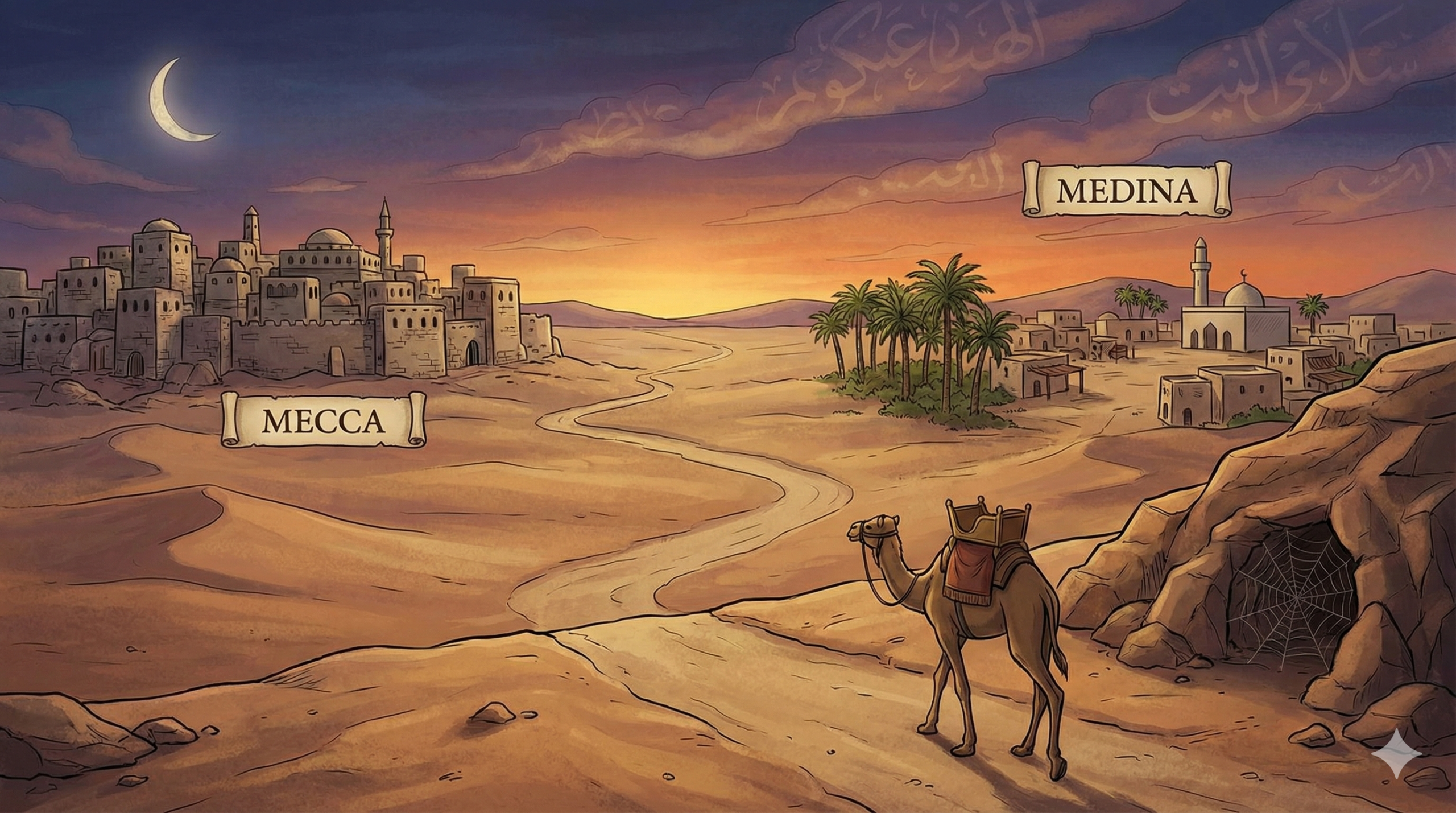
    As an amateur historian of the Middle East and a student of Islamic studies, I find that the journey of Muhammad (PBUH) from a merchant in Mecca to the leader of a burgeoning community in Medina is one of the most compelling narratives in human history. To understand the foundations of Islamic civilization, we must examine the pivotal years that defined the Prophet’s mission.

    The following article, adapted from historical records and oral traditions, explores the early challenges and the eventual migration that changed the course of the world.

    The Rise of a New Faith: From the Mountains of Mecca to the Oasis of Medina

    The story of Islam begins in the rugged terrain of the Hijaz (the western region of the Arabian Peninsula), specifically within the city of Mecca. For the first thirteen years of his mission, Prophet Muhammad (PBUH) preached a message of strict monotheism and social justice to a society deeply rooted in tribal polytheism and economic inequality.

    The Meccan Struggle and the Search for Refuge

    In Mecca, the early Muslim community faced severe persecution. The Quraysh, the dominant tribe and custodians of the Ka’bah (the sacred cuboid building in Mecca), viewed the new faith as a threat to their social order and economic interests.

    • Social Ostracization: Early converts, particularly those from lower social strata or without tribal protection, were subjected to torture and boycotts.
    • The Year of Sorrow: The Prophet suffered deeply personal losses with the deaths of his wife, Khadijah, and his protective uncle, Abu Talib. This left him more vulnerable to the hostility of the Meccan leadership.
    • The Visit to Ta’if: Seeking a new base for his message, the Prophet traveled to the city of Ta’if. However, he was met with rejection and violence, marking one of the most difficult moments of his life.

    The Pledges of Aqaba: A Turning Point

    Despite the hardships in Mecca, the message of Islam began to reach pilgrims visiting the city. Significant breakthroughs occurred at a location called Aqaba, where delegations from the northern city of Yathrib (later renamed Medina) met with the Prophet.

    1. The First Pledge of Aqaba: A group of twelve men from Yathrib accepted Islam and pledged to follow moral and ethical principles, such as avoiding theft, adultery, and the killing of children.
    2. The Second Pledge of Aqaba: A larger group of seventy-three men and two women pledged not only their faith but also their physical protection to the Prophet and his followers.

    This second pledge was the catalyst for the Hijra (the migration), a move that would transform the Muslims from a persecuted minority into a political and social entity.

    The Hijra: The Great Migration (622 CE)

    The migration to Medina was not a simple journey; it was a high-stakes escape. The Meccan leaders, fearing the Prophet would establish a base of power to the north, plotted to assassinate him.

    • The Escape: While his companions emigrated in small groups, the Prophet remained until the final moment. He escaped his home while it was surrounded by assassins, leaving his cousin Ali ibn Abi Talib in his bed as a decoy.
    • The Cave of Thawr: Accompanied by his close friend Abu Bakr, the Prophet hid in a cave on Mount Thawr for three days to evade Meccan search parties.
    • The Arrival in Quba: Before entering the heart of Medina, the Prophet stopped in the suburb of Quba, where he established the first mosque in Islamic history.

    Life in Medina: Building a New Society

    Upon arriving in Medina, the Prophet faced the monumental task of uniting a diverse population. The city was home to various Arab tribes—notably the Aws and Khazraj—as well as several Jewish communities.

    To create stability, the Prophet implemented several social and political reforms:

    • The Brotherhood (Mu’akhah): To integrate the Meccan refugees (Muhajirun) into Medinan society, the Prophet paired each refugee with a local supporter (Ansar). This created a bond of brotherhood that transcended tribal lineage.
    • The Constitution of Medina: This historical document established a confederation between the Muslims, the Jews, and other groups. It granted religious freedom and required all parties to defend the city against external threats.
    • The Construction of the Prophet’s Mosque: The Masjid al-Nabawi became the spiritual, social, and political heart of the community.

    Conclusion: A Legacy of Resilience

    The transition from Mecca to Medina was more than a change of geography; it was a transition from survival to statecraft. For students of history, this period illustrates how a marginalized movement can reshape its destiny through strategic alliances and a steadfast commitment to its core values.


    Join the Conversation We hope this overview provides a clear historical perspective on these foundational events. History is best understood through dialogue and inquiry.

    • What aspects of the Hijra do you find most significant from a political or social standpoint?
    • How do you think the “Brotherhood” system influenced the social fabric of early Medina?

    Please leave your questions or comments below. Whether you are a student of history or a curious reader, we look forward to hearing your thoughts!
  • 2 – Early Life And Lineage

    2 – Early Life And Lineage

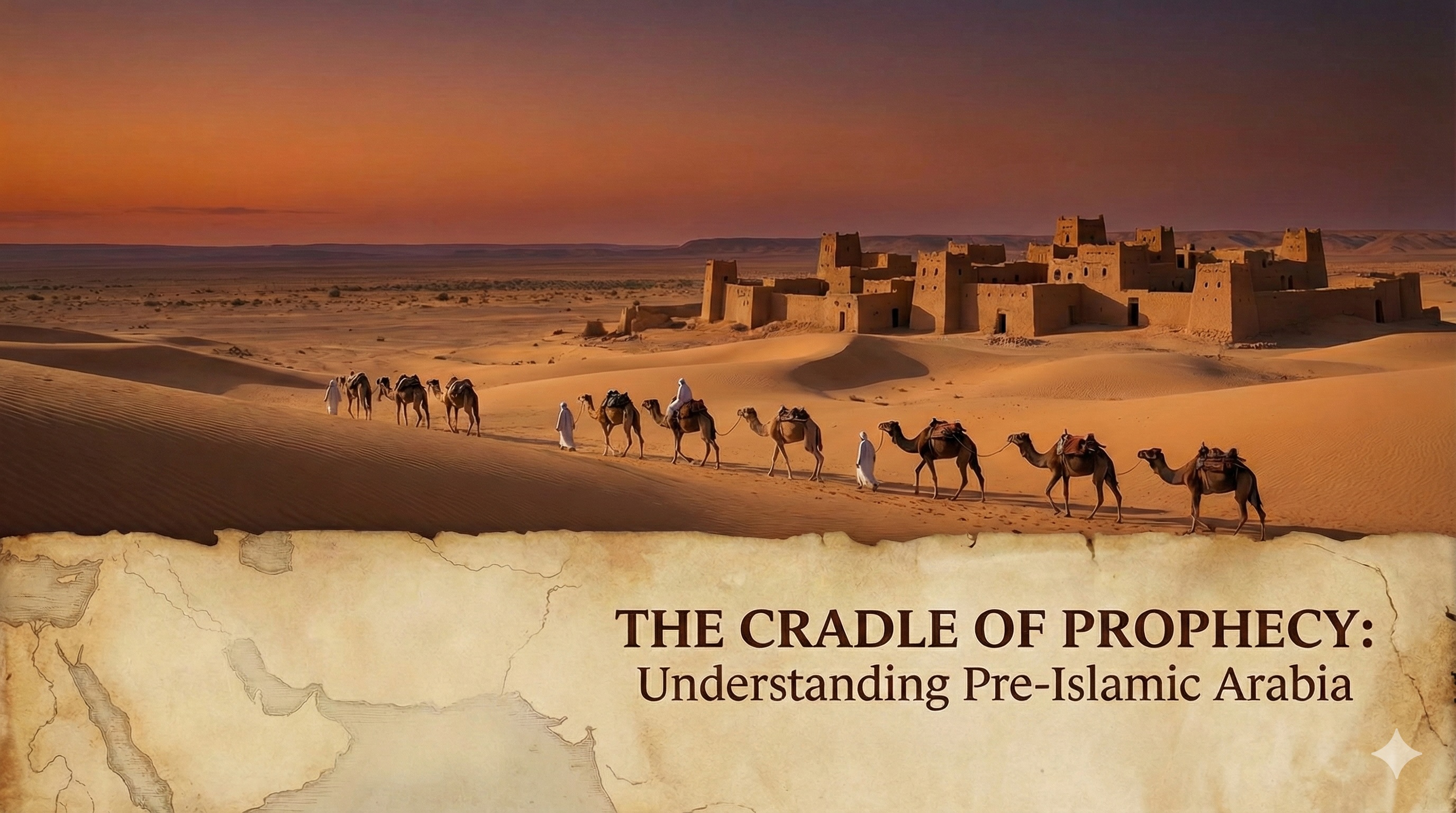
    The Cradle of Prophecy: Understanding Pre-Islamic Arabia

    By Abu Ishaaq Ismail

    To fully appreciate the biography, or Seerah, of the Prophet Muhammad (Peace Be Upon Him), one cannot simply begin with his birth. History is context. Just as a seed requires specific soil to grow, the arrival of the final Prophet was prepared by a unique set of historical, geographical, and social circumstances in the Arabian Peninsula.

    This article explores the world into which the Prophet (PBUH) was born—a period often referred to by Muslim historians as Al-Jahiliyyah, or the Age of Ignorance. We will examine the lineage of the Arabs, their societal structure, and the religious landscape that set the stage for the emergence of Islam.

    The Genealogical Landscape: Origins of the Arabs

    Historians generally categorize the inhabitants of the Arabian Peninsula into three distinct groups based on their lineage and historical presence:

    • The Perished Arabs (Al-Arab Al-Ba’idah): These are the ancient tribes mentioned in the Qur’an and historical texts, such as ‘Ad and Thamud. Their civilizations had long vanished by the time of the Prophet (PBUH), leaving behind only ruins and legends.
    • The Original Arabs (Al-Arab Al-Aribah): Originating from Yemen, these tribes trace their ancestry back to Ya’rub bin Qahtan. They are often referred to as Qahtani Arabs.
    • The Arabized Arabs (Al-Arab Al-Musta’ribah): This group includes the tribe of Quraysh and the lineage of the Prophet Muhammad (PBUH). They are descendants of the Prophet Isma’il (Ishmael), the son of Ibrahim (Abraham), who settled in Makkah and married into the the local Jurhum tribe, learning the Arabic language from them.

    It is through this third group—the Adnani Arabs—that the connection between the Abrahamic tradition and the Arabian Peninsula is established. This lineage is crucial for understanding the Prophet’s (PBUH) role as the fulfillment of Abraham’s prayers.

    Al-Jahiliyyah: The Era of Ignorance

    The term Jahiliyyah is derived from the Arabic root J-H-L, meaning ignorance. In this historical context, it does not necessarily mean a lack of knowledge or intelligence—indeed, the pre-Islamic Arabs were masters of language and survival—but rather a moral and spiritual ignorance.

    Tribalism and Social Structure

    The society was fiercely tribal. Loyalty was not to a state or a law, but to one’s kin. The maxim of the day was, “Support your brother, whether he is the oppressor or the oppressed” (a phrase the Prophet (PBUH) later radically redefined to mean stopping the oppressor).

    • The Ghazwa (Raid): Raiding other tribes for resources was a standard economic activity.
    • Retaliation: Blood feuds could last for generations. A single offense against a tribe member was seen as an offense against the entire clan, necessitating revenge.

    Despite this harshness, the Arabs possessed virtues that would later become pillars of Islamic character: extreme generosity, bravery in the face of death, and an unwavering commitment to keeping one’s word.

    Poetry: The Media of the Desert

    Poetry was the supreme art form. The Arabs celebrated their history, insulted their enemies, and wooed their lovers through intricate verse. A poet was the spokesperson and historian of his tribe. The Mu’allaqat (The Hanging Odes) were seven legendary poems said to have been suspended on the Ka’bah itself—a testament to the high status accorded to eloquence.

    Religious Stagnation: From Monotheism to Idolatry

    Perhaps the most tragic aspect of the Jahiliyyah was the corruption of the monotheistic faith established by Ibrahim and Isma’il. For centuries, Makkah remained steadfast in the worship of the One God. However, over time, idolatry infiltrated the peninsula.

    Tradition identifies a chieftain named Amr ibn Luhay as the catalyst for this change. Traveling to the Levant (modern-day Syria/Jordan), he was impressed by the idol worship he observed there. He brought back an idol named Hubal and placed it in the Ka’bah. This opened the floodgates; soon, every tribe had its own idol, and the House of God became a house of 360 idols.

    • Polytheism (Shirk): The Arabs did not deny the existence of a Supreme Creator (Allah). Rather, they believed these idols were intermediaries needed to approach Him.
    • The Hanifs: Amidst this idolatry, a few individuals known as Hanifs rejected idol worship and attempted to uphold the pure monotheism of Abraham, though they were few and far between.

    Conclusion: A World in Need

    By the late 6th century, the Arabian Peninsula was a land of contrasts. It was a place of poetic beauty and brutal violence, of deep hospitality and spiritual emptiness. The great empires of the day—the Byzantines and Sassanids—ignored the Arabs, viewing their land as an unconquerable and profitless desert.

    Yet, it was in this “ignored” corner of the world, amongst a people fierce in their independence and preserved from the complexities of imperial rule, that the stage was set. The world was spiritually parched, awaiting the rain of revelation.


    Discussion:

    • How do you think the tribal system of pre-Islamic Arabia helped or hindered the initial spread of Islam?
    • What parallels can we draw between the concept of Jahiliyyah and modern societal issues?

    We invite you to leave your thoughts, questions, and comments below.

  • 3 – As A Teenager And Young Man

    3 – As A Teenager And Young Man

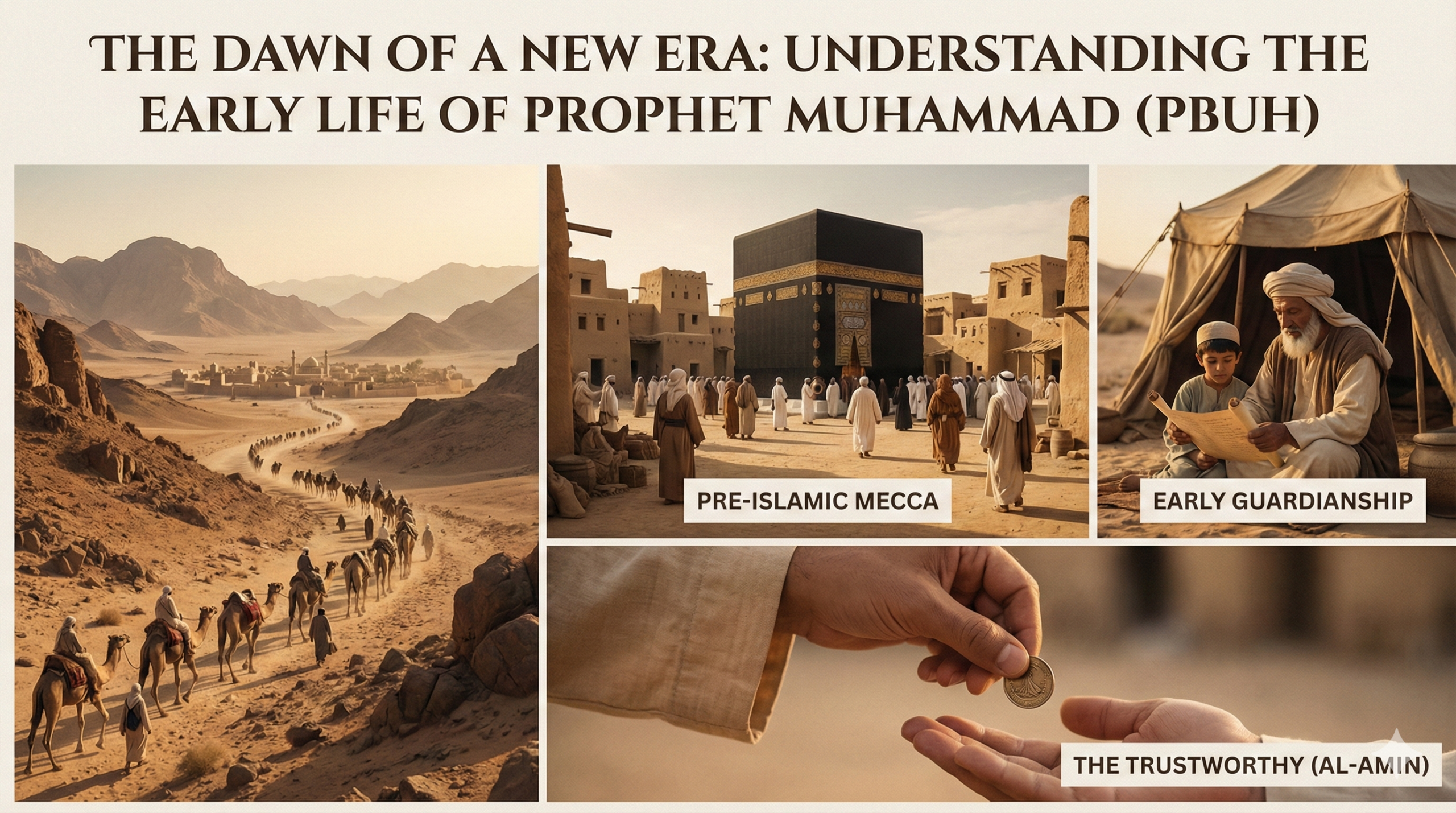
    The Dawn of a New Era: Understanding the Early Life of Prophet Muhammad (PBUH)

    Introduction

    When we approach the history of late antiquity, few figures command as much attention and reverence as Muhammad (Peace Be Upon Him). For students of history, understanding his life is essential not only for grasping the origins of Islam but for comprehending the transformation of the known world in the 7th century. While we analyze these events through an academic lens, it is impossible to ignore the profound spiritual dimension that defines his narrative for billions of people.

    In this article, we will explore the context into which the Prophet was born and the early signs of leadership that distinguished him long before his prophethood began.

    The Context: Arabia Before Islam

    To understand the man, we must understand his environment. 7th-century Arabia was a harsh, tribal society. Historians and theologians often refer to this period as the Jahiliyyah.

    • Jahiliyyah (jah-hil-ee-yah): Often translated as the “Age of Ignorance,” this term refers to the pre-Islamic condition of moral and spiritual chaos in Arabia.

    Mecca, the city of the Prophet’s birth, was a commercial hub, but it was also a place of stark social inequality. Tribal loyalty superseded justice, and the weak often had no protection against the strong. It was in this setting that Muhammad (PBUH) would eventually introduce a message of radical social equality and monotheism.

    Birth and Early Upbringing

    Muhammad (PBUH) was born into the noble tribe of Quraysh, specifically the clan of Banu Hashim. However, his early life was marked by tragedy and instability, a stark contrast to the power his tribe held.

    • Orphanhood: His father, Abdullah, passed away before his birth. His mother, Aminah, died when he was just six years old.
    • Guardianship: He was subsequently raised by his grandfather, Abdul-Muttalib, and later by his uncle, Abu Talib.

    This experience of being an orphan played a crucial role in shaping his character. It instilled in him a deep empathy for the marginalized—the poor, the orphans, and the widows—which would later become a central tenet of his teachings.

    Character Before Prophethood: The Trustworthy

    Long before he received the first revelation at the age of 40, Muhammad (PBUH) was respected by his peers for his integrity. In a society where business dealings could be treacherous, he earned a unique reputation.

    He was widely known by the title Al-Amin.

    • Al-Amin (al-ah-meen): Meaning “The Trustworthy” or “The Honest One.”

    This reputation was so solid that even those who would later oppose his message entrusted their valuables to him for safekeeping. For us as historians, this establishes that his influence was rooted in his personal character long before it was established by religious authority.

    Conclusion

    The early life of Prophet Muhammad (PBUH) offers us a glimpse into the making of a leader who was shaped by hardship and defined by integrity. His upbringing in the harsh environment of Mecca prepared him for the monumental task of delivering a message that would challenge the very foundations of his society.

    In our next article, we will discuss the pivotal moment of Revelation and how it changed the course of history forever.


    Discussion: What aspect of the Prophet’s pre-prophetic life do you find most significant in shaping his later leadership? Do you think his reputation as “Al-Amin” was crucial for his initial acceptance? Leave your thoughts and questions in the comments below!

  • 9 – Abu Talib And Khadijah

    9 – Abu Talib And Khadijah

    In today’s class, we’re going to discuss the following topics:

    • The Sacred Months
    • The death of Abu Talib and Khadijah
    • The Prophet’s marriage to Saudah
    • The Pagans become bolder and intensify their persecution
    • The Prophet begins to look outside of Mecca to relocate
    • The Prophet goes to Taif
    • The revelation of Surah Al-Jinn
  • 14 – Muslims, Hypocrites, And Jews

    14 – Muslims, Hypocrites, And Jews

    In this episode we’ll discuss the following:

    The politics of Medina

    The Aws and Khazraj tribes of Medina

    Dealing with the hypocrites

    The Jewish tribes of Medina