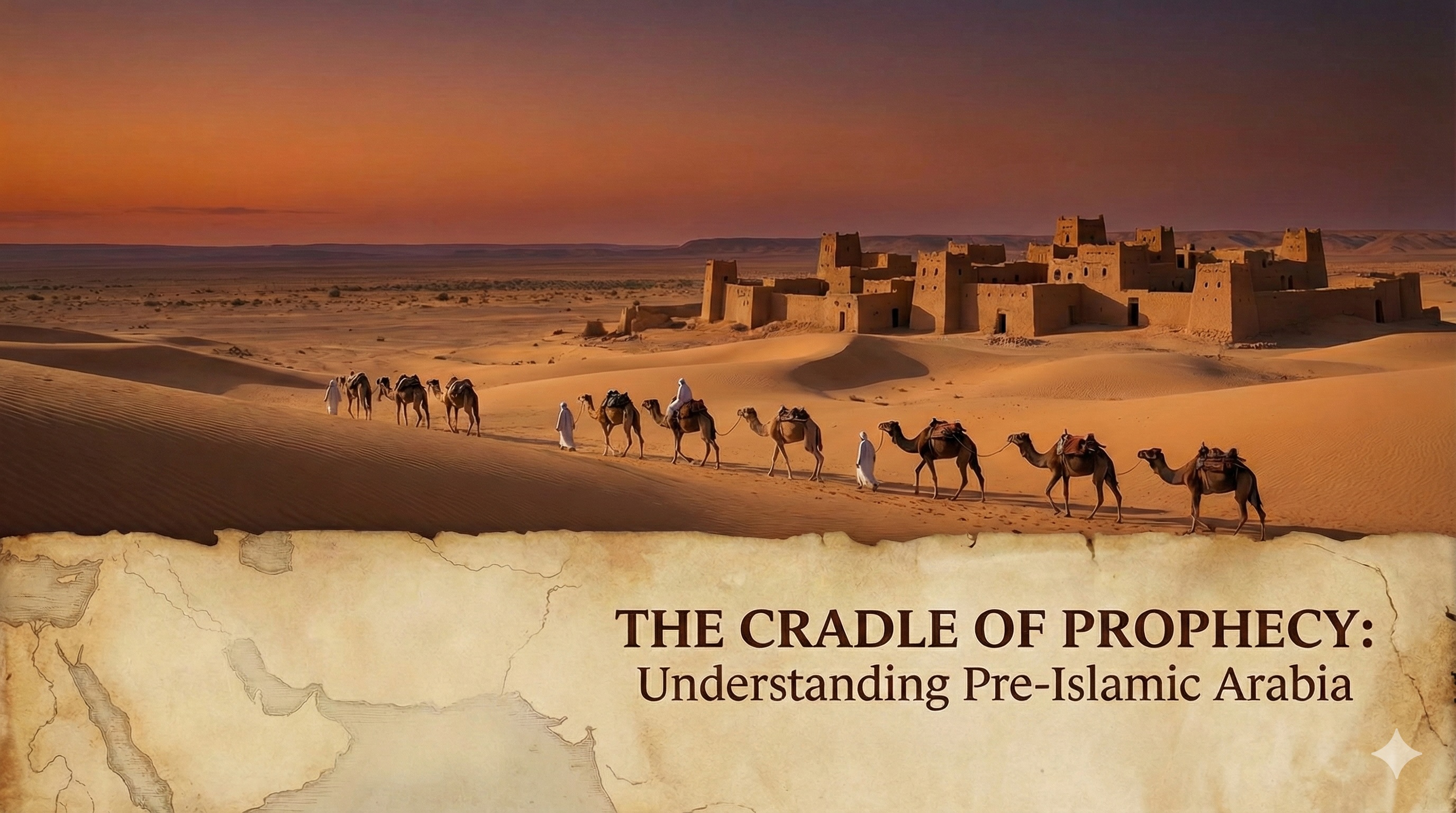
The Cradle of Prophecy: Understanding Pre-Islamic Arabia
By Abu Ishaaq Ismail
To fully appreciate the biography, or Seerah, of the Prophet Muhammad (Peace Be Upon Him), one cannot simply begin with his birth. History is context. Just as a seed requires specific soil to grow, the arrival of the final Prophet was prepared by a unique set of historical, geographical, and social circumstances in the Arabian Peninsula.
This article explores the world into which the Prophet (PBUH) was born—a period often referred to by Muslim historians as Al-Jahiliyyah, or the Age of Ignorance. We will examine the lineage of the Arabs, their societal structure, and the religious landscape that set the stage for the emergence of Islam.
The Genealogical Landscape: Origins of the Arabs
Historians generally categorize the inhabitants of the Arabian Peninsula into three distinct groups based on their lineage and historical presence:
- The Perished Arabs (Al-Arab Al-Ba’idah): These are the ancient tribes mentioned in the Qur’an and historical texts, such as ‘Ad and Thamud. Their civilizations had long vanished by the time of the Prophet (PBUH), leaving behind only ruins and legends.
- The Original Arabs (Al-Arab Al-Aribah): Originating from Yemen, these tribes trace their ancestry back to Ya’rub bin Qahtan. They are often referred to as Qahtani Arabs.
- The Arabized Arabs (Al-Arab Al-Musta’ribah): This group includes the tribe of Quraysh and the lineage of the Prophet Muhammad (PBUH). They are descendants of the Prophet Isma’il (Ishmael), the son of Ibrahim (Abraham), who settled in Makkah and married into the the local Jurhum tribe, learning the Arabic language from them.
It is through this third group—the Adnani Arabs—that the connection between the Abrahamic tradition and the Arabian Peninsula is established. This lineage is crucial for understanding the Prophet’s (PBUH) role as the fulfillment of Abraham’s prayers.
Al-Jahiliyyah: The Era of Ignorance
The term Jahiliyyah is derived from the Arabic root J-H-L, meaning ignorance. In this historical context, it does not necessarily mean a lack of knowledge or intelligence—indeed, the pre-Islamic Arabs were masters of language and survival—but rather a moral and spiritual ignorance.
Tribalism and Social Structure
The society was fiercely tribal. Loyalty was not to a state or a law, but to one’s kin. The maxim of the day was, “Support your brother, whether he is the oppressor or the oppressed” (a phrase the Prophet (PBUH) later radically redefined to mean stopping the oppressor).
- The Ghazwa (Raid): Raiding other tribes for resources was a standard economic activity.
- Retaliation: Blood feuds could last for generations. A single offense against a tribe member was seen as an offense against the entire clan, necessitating revenge.
Despite this harshness, the Arabs possessed virtues that would later become pillars of Islamic character: extreme generosity, bravery in the face of death, and an unwavering commitment to keeping one’s word.
Poetry: The Media of the Desert
Poetry was the supreme art form. The Arabs celebrated their history, insulted their enemies, and wooed their lovers through intricate verse. A poet was the spokesperson and historian of his tribe. The Mu’allaqat (The Hanging Odes) were seven legendary poems said to have been suspended on the Ka’bah itself—a testament to the high status accorded to eloquence.
Religious Stagnation: From Monotheism to Idolatry
Perhaps the most tragic aspect of the Jahiliyyah was the corruption of the monotheistic faith established by Ibrahim and Isma’il. For centuries, Makkah remained steadfast in the worship of the One God. However, over time, idolatry infiltrated the peninsula.
Tradition identifies a chieftain named Amr ibn Luhay as the catalyst for this change. Traveling to the Levant (modern-day Syria/Jordan), he was impressed by the idol worship he observed there. He brought back an idol named Hubal and placed it in the Ka’bah. This opened the floodgates; soon, every tribe had its own idol, and the House of God became a house of 360 idols.
- Polytheism (Shirk): The Arabs did not deny the existence of a Supreme Creator (Allah). Rather, they believed these idols were intermediaries needed to approach Him.
- The Hanifs: Amidst this idolatry, a few individuals known as Hanifs rejected idol worship and attempted to uphold the pure monotheism of Abraham, though they were few and far between.
Conclusion: A World in Need
By the late 6th century, the Arabian Peninsula was a land of contrasts. It was a place of poetic beauty and brutal violence, of deep hospitality and spiritual emptiness. The great empires of the day—the Byzantines and Sassanids—ignored the Arabs, viewing their land as an unconquerable and profitless desert.
Yet, it was in this “ignored” corner of the world, amongst a people fierce in their independence and preserved from the complexities of imperial rule, that the stage was set. The world was spiritually parched, awaiting the rain of revelation.
Discussion:
- How do you think the tribal system of pre-Islamic Arabia helped or hindered the initial spread of Islam?
- What parallels can we draw between the concept of Jahiliyyah and modern societal issues?
We invite you to leave your thoughts, questions, and comments below.
Leave a Reply