The Dawn of a New Era: Understanding the Early Life of Prophet Muhammad (PBUH)
Introduction
When we approach the history of late antiquity, few figures command as much attention and reverence as Muhammad (Peace Be Upon Him). For students of history, understanding his life is essential not only for grasping the origins of Islam but for comprehending the transformation of the known world in the 7th century. While we analyze these events through an academic lens, it is impossible to ignore the profound spiritual dimension that defines his narrative for billions of people.
In this article, we will explore the context into which the Prophet was born and the early signs of leadership that distinguished him long before his prophethood began.
The Context: Arabia Before Islam
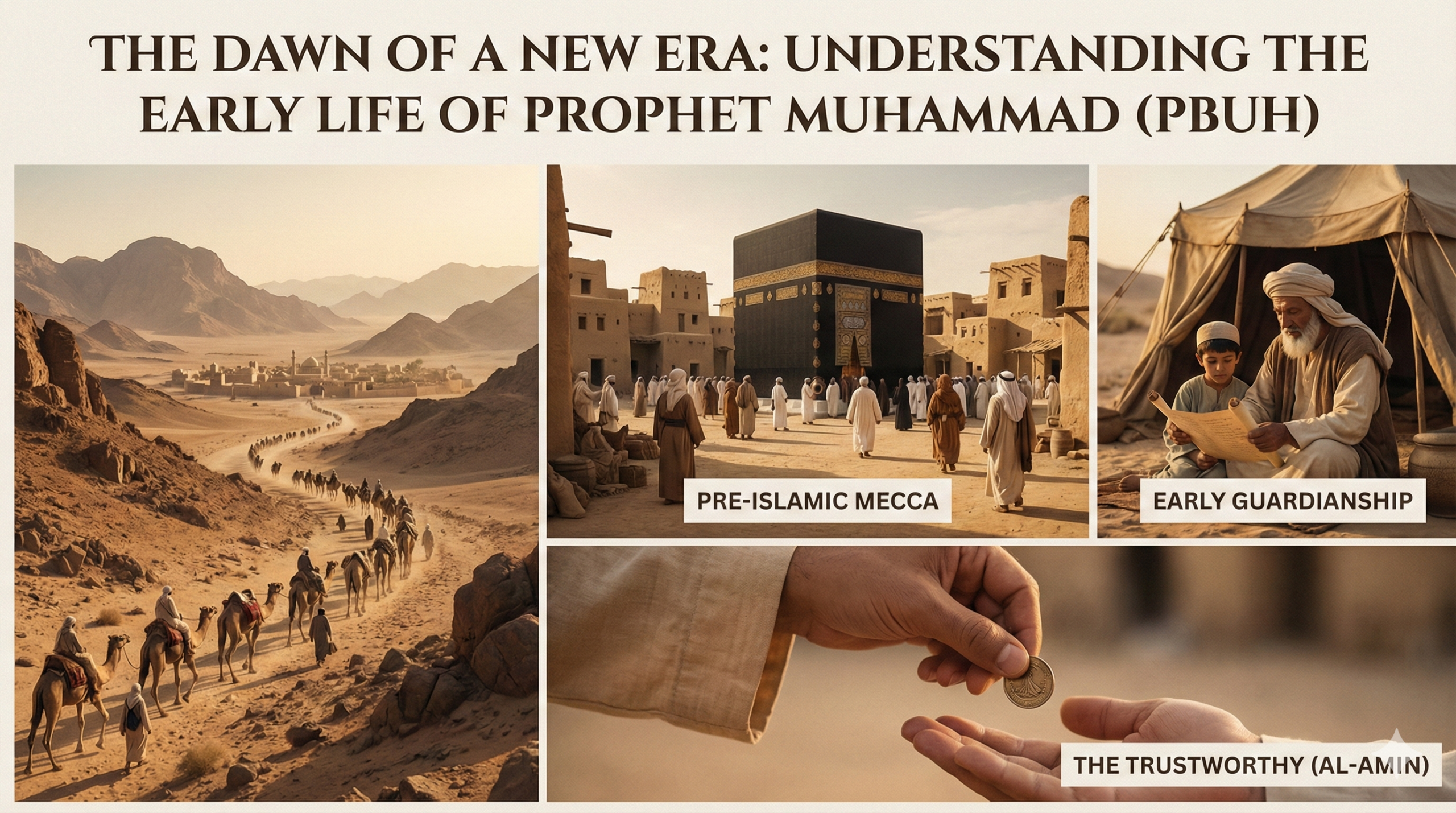
To understand the man, we must understand his environment. 7th-century Arabia was a harsh, tribal society. Historians and theologians often refer to this period as the Jahiliyyah.
- Jahiliyyah (jah-hil-ee-yah): Often translated as the “Age of Ignorance,” this term refers to the pre-Islamic condition of moral and spiritual chaos in Arabia.
Mecca, the city of the Prophet’s birth, was a commercial hub, but it was also a place of stark social inequality. Tribal loyalty superseded justice, and the weak often had no protection against the strong. It was in this setting that Muhammad (PBUH) would eventually introduce a message of radical social equality and monotheism.
Birth and Early Upbringing
Muhammad (PBUH) was born into the noble tribe of Quraysh, specifically the clan of Banu Hashim. However, his early life was marked by tragedy and instability, a stark contrast to the power his tribe held.
- Orphanhood: His father, Abdullah, passed away before his birth. His mother, Aminah, died when he was just six years old.
- Guardianship: He was subsequently raised by his grandfather, Abdul-Muttalib, and later by his uncle, Abu Talib.
This experience of being an orphan played a crucial role in shaping his character. It instilled in him a deep empathy for the marginalized—the poor, the orphans, and the widows—which would later become a central tenet of his teachings.
Character Before Prophethood: The Trustworthy
Long before he received the first revelation at the age of 40, Muhammad (PBUH) was respected by his peers for his integrity. In a society where business dealings could be treacherous, he earned a unique reputation.
He was widely known by the title Al-Amin.
- Al-Amin (al-ah-meen): Meaning “The Trustworthy” or “The Honest One.”
This reputation was so solid that even those who would later oppose his message entrusted their valuables to him for safekeeping. For us as historians, this establishes that his influence was rooted in his personal character long before it was established by religious authority.
Conclusion
The early life of Prophet Muhammad (PBUH) offers us a glimpse into the making of a leader who was shaped by hardship and defined by integrity. His upbringing in the harsh environment of Mecca prepared him for the monumental task of delivering a message that would challenge the very foundations of his society.
In our next article, we will discuss the pivotal moment of Revelation and how it changed the course of history forever.
Discussion: What aspect of the Prophet’s pre-prophetic life do you find most significant in shaping his later leadership? Do you think his reputation as “Al-Amin” was crucial for his initial acceptance? Leave your thoughts and questions in the comments below!