
Category: Quran

  • 4 – His Daughters And His Mission

    4 – His Daughters And His Mission

    The House of the Prophet and the Dawn of Revelation

    In the study of Islamic history, the biography of the Prophet Muhammad (peace be upon him) serves as the foundational narrative upon which the religion, culture, and civilization of the Muslim world are built. Before we delve into the momentous event of the first revelation, it is essential to understand the domestic context of the Prophet’s life. To understand the Messenger, we must first understand the man: a father, a husband, and a contemplative soul seeking truth in a chaotic world.

    This article explores the family dynamics of the Prophet’s household, specifically the lives of his daughters, and recounts the transformative moment in the Cave of Hira that altered the course of human history.


    The Daughters of the Prophet (PBUH)

    While historical narratives often focus heavily on the male companions of the Prophet, the domestic sphere was defined by the presence of his four daughters. All born to his first wife, Khadija, these women played pivotal roles in the early years of Islam.

    • Zainab: The eldest daughter. She was married to her cousin, Abu al-Aas ibn Rabee, a man of the Quraysh tribe. Unlike her sisters, her husband did not immediately convert to Islam. When the Prophet migrated to Medina, Zainab initially remained in Mecca. Her story is one of complex loyalties and eventual reunification; her husband eventually embraced Islam, and they were reunited in Medina shortly before her death.
    • Ruqayyah: The second daughter. Her early life illustrates the intense tribal hostilities the Prophet faced. She was initially married to Utbah, the son of Abu Lahab (one of the Prophet’s fiercest uncles and enemies). However, as the message of Islam began to spread, Abu Lahab forced his son to divorce her as an act of spite. Ruqayyah subsequently married Uthman ibn Affan, one of the earliest converts and a future Caliph. They migrated together to Abyssinia (modern-day Ethiopia) to escape persecution and later to Medina. She passed away during the Battle of Badr.
    • Umm Kulthum: Like her sister Ruqayyah, Umm Kulthum was also married to a son of Abu Lahab (Utaibah) and was similarly divorced due to political and religious pressure from her father-in-law. After the death of Ruqayyah, Umm Kulthum also married Uthman ibn Affan. This unique distinction—marrying two daughters of the Prophet—earned Uthman the title Dhun-Nurayn (The Possessor of Two Lights). She died approximately six years after the migration to Medina.
    • Fatimah: The youngest and perhaps most historically significant of the daughters. She is often cited as the Prophet’s favorite. She married the Prophet’s cousin, Ali ibn Abi Talib, and through them, the Prophet’s lineage continued. Their children—Hassan, Hussein, Zainab, and Umm Kulthum—hold an exalted status in Islamic history.

    A Note on Historical Perspectives

    It is important for students of history to recognize that the life of Fatimah and her husband Ali is a primary point of divergence between Sunni and Shia Muslims. While Sunni tradition respects all the Prophet’s family and companions (Sahaba), Shia tradition places a specific, elevated spiritual emphasis on Ali and Fatimah as the specific Ahl al-Bayt (People of the House).

    Academics must navigate these narratives carefully. The “middle path”—often identified with the Sunni tradition—honors the family of the Prophet deeply without rejecting the validity of his other companions, such as Abu Bakr or Umar, whom some sectarian narratives may disparage.


    The Seclusion and the First Revelation

    Around the year 610 CE, as Muhammad (PBUH) approached the age of 40, his behavior began to change. He grew increasingly disillusioned with the idolatry and social injustices of Meccan society. Seeking solace, he began a practice of spiritual seclusion in the Cave of Hira, located on Jabal al-Nour (The Mountain of Light) on the outskirts of Mecca.

    It was here, during the month of Ramadan, that the silence was broken.

    The Encounter with the Archangel

    According to primary sources, the Angel Jibril (Gabriel) appeared to Muhammad in the cave. This was not a dream, but a visceral, overwhelming physical encounter. The Angel issued a single command:

    “Iqra!”

    This Arabic imperative is rich in meaning. It translates to “Read!” or “Recite!” The Prophet, terrified and unlettered, replied: “Ma ana bi qari” (“I am not a reader/reciter”).

    The tradition recounts that the Angel embraced the Prophet, squeezing him tight until he could arguably bear it no longer, and then released him, repeating the command. This happened three times. Finally, the first verses of the Quran (Surah Al-Alaq, 96:1-5) were revealed:

    “Read in the name of your Lord who created. Created man from a clinging substance. Read, and your Lord is the most Generous. Who taught by the pen. Taught man that which he knew not.”

    The “Clot” and the Linguistic Miracle

    The verses mention creating man from Alaq. In Arabic, Alaq can mean a “clot,” a “leech-like substance,” or “something that clings/hangs.” While some modern apologists point to this as a scientific miracle describing the human embryo implantation in the uterus, historians and theologians often emphasize that the primary miracle of the Quran was linguistic. To the 7th-century Arab, poetry and language were the ultimate art forms. The Quranic revelation arrived with a literary quality that superseded anything known to the masters of Arabic poetry at the time.


    Khadija: The Anchor of Support

    The immediate aftermath of the revelation is deeply humanizing. The Prophet did not descend from the mountain triumphant; he ran home terrified, trembling, shouting to his wife, “Zammilooni! Zammilooni!” (“Cover me! Cover me!”).

    It is here that we see the immense historical weight of Khadija. She did not dismiss his fears, nor did she question his sanity. Instead, she provided the first validation of his prophethood. She comforted him with a logical assessment of his character, reminding him:

    • You are kind to your family.
    • You carry the burdens of the weak.
    • You help the poor and the needy.
    • You are hospitable to guests.
    • You assist people in times of calamity.

    She argued that God would not disgrace a man of such moral standing.

    The Prediction of Waraqa ibn Nawfal

    To seek further understanding, Khadija took Muhammad (PBUH) to her cousin, Waraqa ibn Nawfal. Waraqa was an elder Christian scholar who was familiar with the Hebrew and Christian scriptures. Upon hearing the Prophet’s account, Waraqa identified the figure in the cave as the Namus—a term likely derived from the Greek Nomos (Law), referring to the Archangel Gabriel who brought the Law to Moses.

    Waraqa validated the experience but offered a somber prediction: “I wish I could be young when your people drive you out.” When the Prophet asked in shock if his own people would exile him, Waraqa confirmed a universal historical truth: No man brings such a transformative message without facing hostility from his society.

    Conclusion

    The revelation in the Cave of Hira marked the transition of Muhammad (PBUH) from a private citizen of Mecca to the Messenger of God. Yet, this transition was grounded in the stability of his household. The support of his daughters and the unwavering faith of his wife Khadija provided the emotional foundation necessary to bear the weight of the message that would soon transform the Arabian Peninsula and the world.


    Discussion Question: How does the domestic life of the Prophet, particularly Khadija’s reaction to the first revelation, challenge or support Western perceptions of gender roles in early Islamic history?

    Please share your thoughts and questions in the comments below.
  • 5 – The First Three Years Of Revelation

    5 – The First Three Years Of Revelation

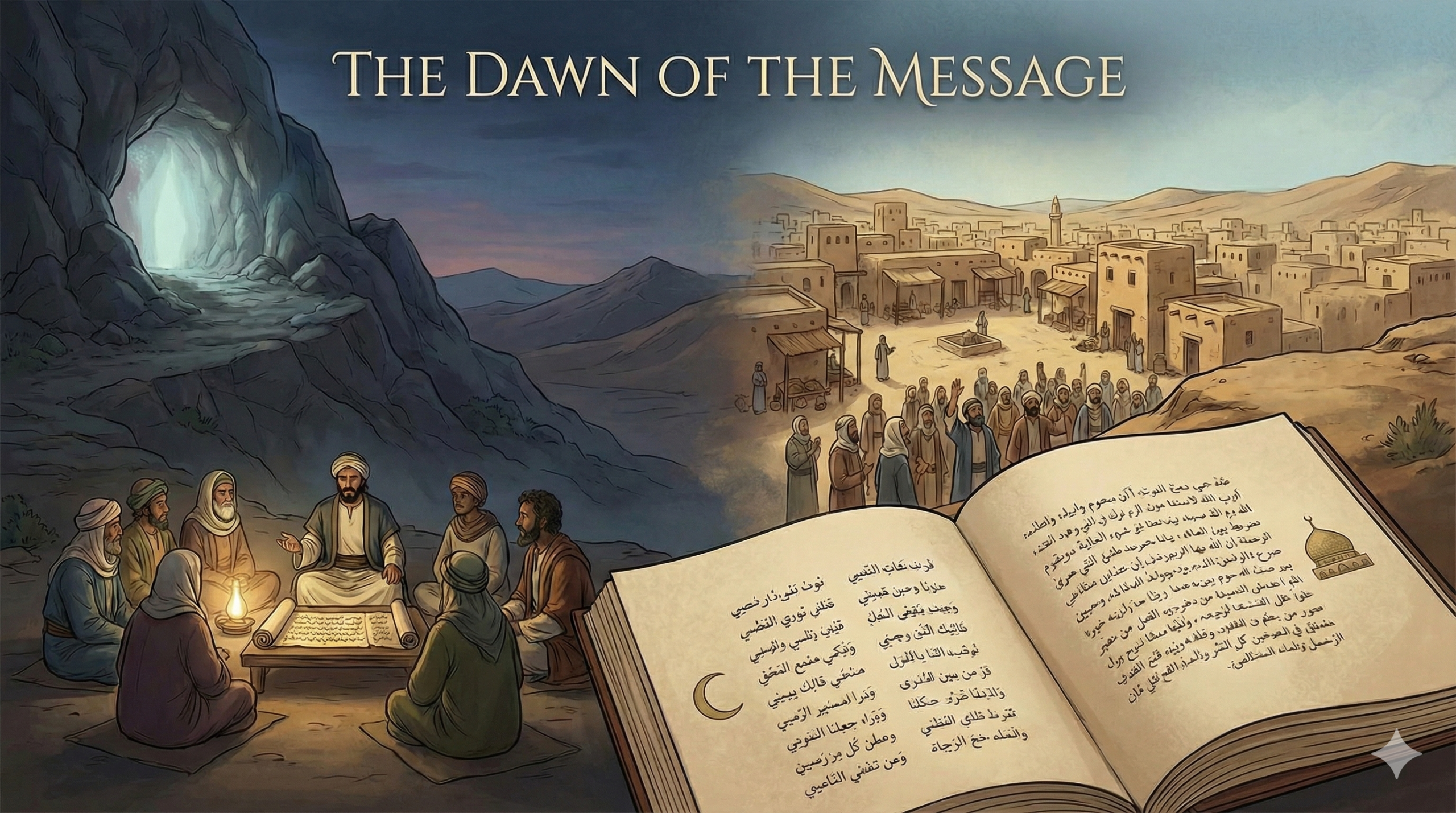
    The Dawn of the Message: Revelation, Early Companions, and the Structure of Islamic Law

    Introduction

    In our study of the life of Prophet Muhammad (PBUH), we previously examined the momentous occasion of the first revelation in the Cave of Hira. However, the path of prophethood was rarely a continuous stream of divine interaction. Following that initial, earth-shattering encounter with the Archangel Gabriel (Jibril), the revelations did not continue immediately. There was a period of silence, known as the Fatrah, where the heavens seemed to close.

    This silence lasted for a period debated by scholars—estimates range from a few days to several months, though a few weeks is a likely duration. For the Prophet (PBUH), this was a time of intense anxiety. He feared he might be losing his mind or becoming a soothsayer—a figure he deeply disliked. His wife’s cousin, Waraqah ibn Nawfal, reassured him, counseling patience and confirming his prophethood.

    Eventually, the silence broke. Gabriel returned, not just with reassurance, but with a command that would shift the Prophet’s role from a private believer to a public warner.

    The Command to Arise and Warn

    The resumption of revelation began with the opening verses of Surah Al-Muddathir (The Cloaked One). The verses issued a direct directive:

    • “Arise and warn” (Qum fa-andhir): A command to stand up and begin spreading the message.
    • “And your Lord glorify” (Wa rabbaka fa-kabbir): A call to proclaim the greatness of God.
    • “And your clothing purify” (Wa thiyabaka fa-tahhir): An instruction for both physical cleanliness and internal spiritual purification.
    • “And for your Lord, be patient” (Wa li-rabbika fa-sbir): A forewarning that the path ahead would be fraught with trials requiring immense patience.

    Following this, the revelations began to descend frequently and strongly.

    The Modes of Divine Revelation

    To understand the Islamic tradition, one must understand how this communication occurred. The Prophet (PBUH) experienced revelation in several distinct forms:

    • The Ringing Bell: Sometimes revelation arrived like the loud clanging of a bell, a heavy and intense experience that served as a warning before the message was impressed upon his heart and mind.
    • Angelic Form: The Prophet (PBUH) sometimes saw the Angel Gabriel in his true angelic form, filling the horizon.
    • Human Form: Gabriel often appeared as a man. A famous account, known as the “Hadith of Gabriel,” describes a man with exceedingly white clothes and black hair questioning the Prophet about faith and practice to teach the companions.
    • True Dreams: The dreams of the Prophets are considered truth. Even after his call to prophethood, dreams remained a medium of divine instruction.

    The Pioneers: The Early Muslim Community

    For the first three years, the mission remained secretive, shared only with close family and trusted friends. During this period, the community grew slowly, numbering perhaps only 40 individuals.

    This group became the bedrock of Islamic history. The most prominent among them was Abu Bakr, a wealthy and respected merchant roughly the same age as the Prophet. Abu Bakr was instrumental in spreading the faith to his peers in the merchant class, bringing in future leaders who would shape the Muslim world.

    The Ten Promised Paradise (Al-Ashara Al-Mubashara)

    Islamic tradition holds a special status for ten specific companions who were promised Paradise in a single prophetic narration. These include:

    • Abu Bakr: The closest companion and first Caliph (successor).
    • Umar ibn al-Khattab: Initially a fierce opponent, he later converted and became the second Caliph. His conversion was a pivotal moment for the morale of the early Muslims.
    • Uthman ibn Affan: A wealthy son-in-law of the Prophet and the third Caliph.
    • Ali ibn Abi Talib: The Prophet’s cousin who lived in his household, and the fourth Caliph.
    • Talha ibn Ubaydullah & Zubayr ibn al-Awwam: Two close friends and fierce warriors who accepted Islam as young men.
    • Abd al-Rahman ibn Awf: An astute businessman known for his immense generosity and financial independence.
    • Sa’d ibn Abi Waqqas: An early convert from the merchant class.
    • Abu Ubaidah ibn al-Jarrah: A trustworthy leader who later commanded Muslim armies in Syria.
    • Sa’id ibn Zayd: Raised as a monotheist by his father even before Islam, he naturally gravitated toward the Prophet’s message.

    It is important to note that the promise of Paradise was not limited to these men; others, like Bilal ibn Rabah, the Abyssinian slave who endured horrific torture for his faith, were also given glad tidings of salvation.

    The Evolution of the Quran: Meccan vs. Medinan Verses

    As students of history, we can distinguish between the phases of the Quranic revelation based on where the Prophet was living: Mecca or Medina.

    Meccan Verses: Revealed during the first 13 years in Mecca, these verses focus primarily on theology and faith (Iman). They address the Oneness of God (Tawhid), the reality of the afterlife, and the moral rectification of the individual. They are characterized by short, rhythmic verses that emphasize the “Great Event” of Judgment Day, such as those found in Surah Al-Waqi’a.

    Medinan Verses: Revealed after the migration to Medina, these verses focus on community building and law. Here we find the rules of Sharia (Islamic law)—instructions on divorce, inheritance, warfare, and social transactions. These verses tend to be longer and more prose-like, detailing the legal boundaries of the new society.

    Understanding Islamic Law: Sharia vs. Fiqh

    A critical distinction in Islamic studies is the difference between Sharia and Fiqh, terms often used interchangeably in the West but which hold distinct meanings.

    • Sharia (The Revealed Way): This refers to the divine, immutable laws found directly in the Quran and the authentic sayings of the Prophet. For example, the prohibition of pork or the mandate to pray are Sharia—fixed and unchangeable.
    • Fiqh (Understanding/Jurisprudence): This is the human attempt to apply divine principles to changing circumstances. Fiqh is dynamic and adaptable. It involves scholars deriving rulings for new situations that did not exist in the 7th century.

    The purpose of this legal framework is not just blind adherence to rules, but the establishment of justice. While secular law often prioritizes the “rule of law” even if the outcome is unjust, Islamic legal theory prioritizes justice and necessity, allowing for exceptions (such as eating forbidden food to avoid starvation) when rigid application would cause harm.

    The Public Proclamation

    After three years of secret preaching, the command came to “warn your closest kindred”. The Prophet (PBUH) climbed Mount Safa and called out to the tribes of Mecca. When they gathered, he asked, “If I told you an army was behind this mountain, would you believe me?” They replied yes, affirming his reputation as Al-Amin (The Trustworthy).

    He then declared his messengership. The silence was broken by his uncle, Abu Lahab, who cursed him. This rejection marked the end of the quiet years and the beginning of open persecution, setting the stage for the struggles that would define the Meccan period.


    We hope this article has provided a clear overview of the early Prophetic mission. The history of this period is vast and deep. What are your thoughts on the distinction between the Meccan and Medinan periods? Do you have questions about the early companions? Please leave your comments and questions below!

  • 6 – The Persecution Begins

    6 – The Persecution Begins

    In today’s class we’re going to discuss the following topics:

    • The prophet makes the call to all the Quraish
    • Debates and discussions between the Pagans and the Prophet
    • The Quran becomes more assertive and the Quraish push back
    • Responding to so-called contradictions in the Quran
    • Reasons the Quraish resisted the message of Islam
    • The Quraish begin to persecute the weaker Muslims
  • 7 – The Persecution Of Bilal And Ammar

    7 – The Persecution Of Bilal And Ammar

    In this lesson we’ll discuss the following:

    • The Quraish try to bribe the Prophet
    • The persecution of Bilal ibn Rabah
    • The persecution of Ammar ibn Yasar and his family
    • The first migration to Abyssinia
    • The revelation of Surah Al-Kahf
    • The Mongols conquest of the Muslim lands
    • The revelation of Surah An-Najm
    • The so-called Satanic Verses and Salman Rushdie
  • 9 – Abu Talib And Khadijah

    9 – Abu Talib And Khadijah

    In today’s class, we’re going to discuss the following topics:

    • The Sacred Months
    • The death of Abu Talib and Khadijah
    • The Prophet’s marriage to Saudah
    • The Pagans become bolder and intensify their persecution
    • The Prophet begins to look outside of Mecca to relocate
    • The Prophet goes to Taif
    • The revelation of Surah Al-Jinn
  • 10 – Al Isra’ Wal Mi’raj

    10 – Al Isra’ Wal Mi’raj

    In this class we’ll discuss the following:

    • The conversion of Abu Dharr Al-Ghifari
    • The first delegation from Yathrib
    • The message begins to spread in Yathrib
    • The Night Journey and Ascension
    • Link to hadith about Al-Isra wal-Miraj
    • The 5 daily prayers are established
    • The lessons of The night journey and ascension